9.03.2011

Atlantic Ridley Sea Turtle and Moon Jelly


Atlantic Ridley (Lepidochelys kempii)


Moon Jelly (Aurelia sp.)

Orchids

Rose Pogonia (Pogonia ophioglossoides)

Upland Spreading Pogonia (Pogonia bifaria)

Tuberous Grass-pink (Calopogon tuberosus)

Bearded Grass-pink (Calopogon barbatus)

Pale Grass-pink (Calopogon pallidus)

Yellow Fringed Orchid (Platanthera ciliaris)

White Fringed Orchid (Platanthera blephariglottis var. conspicua)

Snowy Orchid (Habenaria nivea)

Waterspider False Reinorchid (Habenaria repens)

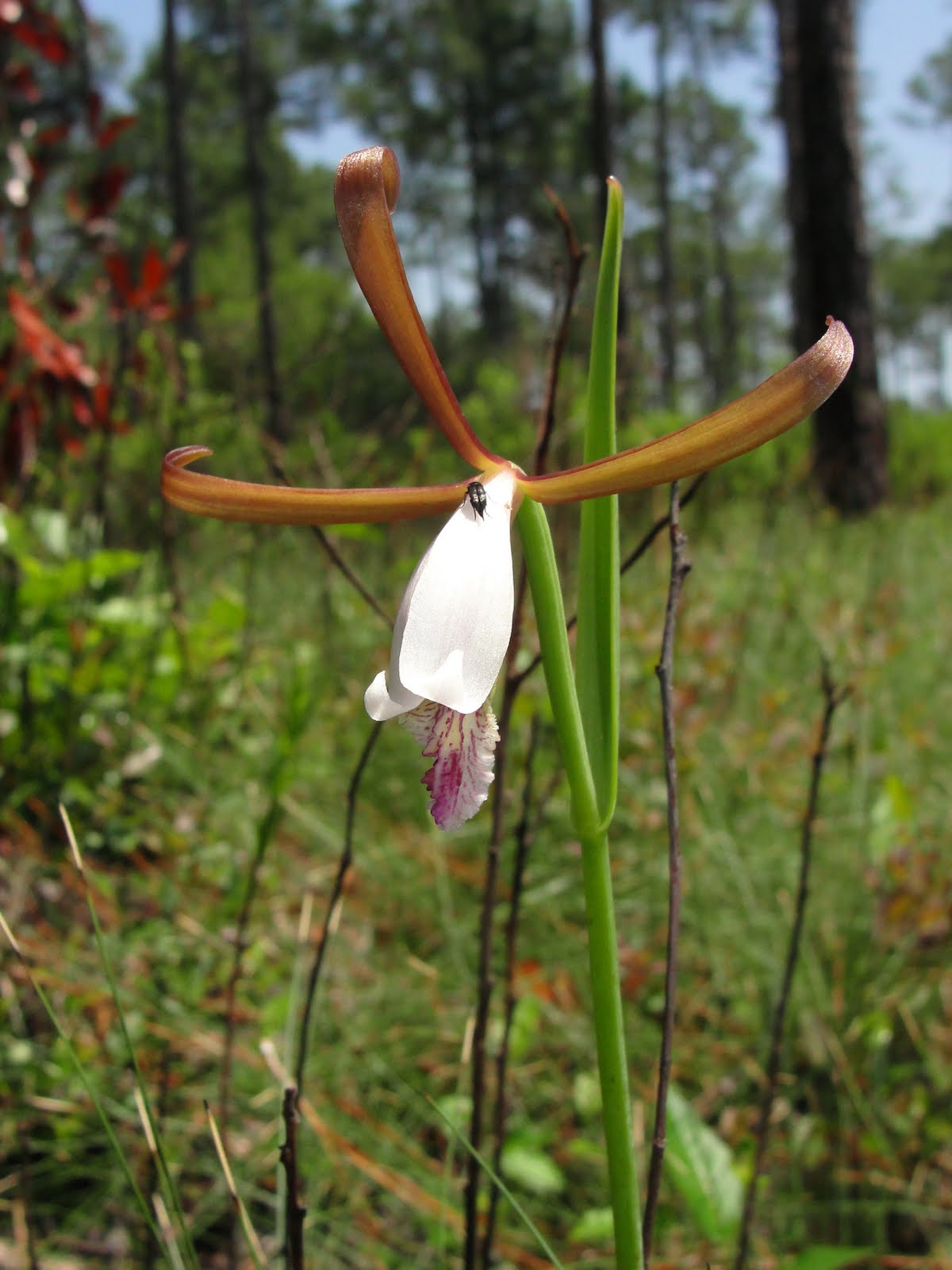
Little Ladies'-tresses (Spiranthes tuberosa)

Giant Ladies'-tresses (Spiranthes praecox)

Common Snapping Turtle family photo


Common Snapping Turtle (Chelydra serpentina)

I jumped into a local stream to grab what I thought was certainly an alligator snapping turtle (Macrochelys temminckii), and only realized after grabbing it that it was a huge common snapping turtle! Elliott was understandably both impressed and intimidated. It was fun and funny to me to take a little family photo with the turtle! I put the turtle down a few meters back from the water just to see how it would do on land. It was a surprisingly strong walker, lifting its plastron completely off the ground rather than sliding, as it made it's way into the water and promptly disappeared in the shadows. (photos by William, a friendly guy at the park who had already been pointing at the turtle when we walked up)

5.13.2011

Scaly Beasts


Rough Green Snake (Opheodrys aestivus)


Eastern Diamondback Rattlesnake (Crotalus adamanteus) in Gopher Tortoise (Gopherus polyphemus) burrow


Eastern Diamondback Rattlesnake (Crotalus adamanteus)


Florida Pine Snake (Pituophis melanoleucus mugitus)


Eastern Fence Lizard (Sceloporus undulatus)


Six-lined Racerunner (Aspidoscelis sexlineata) copulating in a not so comfortable looking position

3.19.2011

The other flatwoods salamander

For the past few years I've had the opportunity to work with one of the two species of flatwoods salamander, Ambystoma bishopi. Though they don't really look different to my eye, I've wanted to see the other species, Ambystoma cingulatum. A couple friends have taken me to see some of the habitat they use, but it wasn't at the best time to see the animals. During a great extended weekend trip that Sarah and I took last week we visited one of the breeding sites shortly after dark. We were fortunate to spot this larval individual in the shallow water!


Frosted Flatwoods Salamander (Ambystoma cingulatum)


Calling frogs, including Spring peepers, made our evening even more enjoyable.


Spring peeper (Pseudacris crucifer)

Note: All the little light-colored flecks on the water and on the Spring peeper are pine pollen, which was on everything!

2.19.2011

Winter frogs


I was pleased to see this large, rare, and secretive frog that my friend Stephen spotted on a recent rainy night while we were out in the field.


Carolina gopher frog (Lithobates capito)


Ornate chorus frog (Pseudacris ornata)


Eastern spadefoot (Scaphiopus holbrookii)


Eastern spadefoot burying itself after coming to the surface during a heavy winter rain. Eastern spadefoots certainly come out in the winter, but will be active seemingly any time of year during, or immediately following, heavy rains.

2.10.2011

All it takes is a warmer day

In Florida, winter does not equal the deep sleep for cold-blooded animals that it does in the more northerly states. We've had a few warm nights recently, and I've enjoyed seeing what comes out to take advantage of it.


Scarlet kingsnake (Lampropeltis elapsoides)


Eastern hognose (Heterodon platirhinos) in gopher tortoise (Gopherus polyphemus) burrow.


Eastern garter snake (Thamnophis sirtalis)

2.07.2011

A botanical icy surprise


We've had quite a few nights with temps below freezing down in the Florida panhandle this winter. While out checking some of our wetlands in the morning, I was surprised to see dozens of these delicate and beautiful ice structures formed out of plant fluids being drawn up through nearly dead annual herbs (seemingly all one species of asteraceae but not sure on id in this shape). The vascular tissue had apparently ruptured from the expansion of the freezing fluid, yet the fluid continued to flow, freezing as it left the plant tissues to form numerous fine sheets of ice. That is what seemed to make sense to me, but I would love to hear your thoughts if you have any. I would also be interested to hear if anyone has seen or heard of this before. The structures were very fragile and would shatter easily and pieces would melt in the hand rather quickly. I was impressed, and thought that it would be difficult for any human to form anything quite so delicate out of ice.

Follow up: My friend Ben told me the term for these icy structures is "Frost flowers." Here's a link to a more in depth description of how they form. Thanks Ben!