8.13.2008

Shawn's visit

Our friend Shawn flew down to visit us this past weekend, and we fit in quite a bit in just a couple days. We all ate enough food to ensure that no one would lose any weight. We also did the beach thing, living out our "use it while you've got it" philosophy. We spent one evening out herping on Eglin. Of course I hate herping, but Shawn and Sarah talked me into it. Our friend Brandon came with us, and we started out the night by helping him track down some radio-tagged Florida Bog Frogs (Rana okaloosae) and Bronze Frogs (Rana clamitans).

By necessity, we stocked up on some pre-herping junk food.


In addition to the bog and bronze frogs, Shawn got to see and interact with some other fun species.


Southern Toad (Bufo terrestris) Do toads turn into princesses?


Banded Water Snake (Nerodia fasciata)


A highlight for me was that Shawn found and handled this Cottonmouth (Agkistrodon piscivorus), which was the first of three that we were to find that night.


I took Shawn out spearfishing on his last day here. I figured correctly that he would like it. Not only did he like it, he also did quite well, shooting the sheepshead (Archosargus probatocephalus) in the front right, a spadefish (Chaetodipterus faber) that is mostly hidden by the fish in front, and an impressive mangrove snapper (Lutjanus griseus) caught later that was never photographed. I shot the Jack crevalle (Caranx hippos) on the front left, even though I'd been told by many people (none of which had actually tried it for themselves) that they taste like crap, and that they have soft, bloody meat. I'm usually open to trying a lot of things at least once to form my own opinion. Interestingly, the meat was quite firm, not unusually bloody, and rather like the meat of tuna. So, if you think fresh tuna tastes like crap, don't eat Jack crevalle.

7.28.2008

fitter, happier, more productive

Now that I'm in my late twenties and I sit around working on a computer all day, I decided I should probably be more intentional about getting some regular physical activity. That, coupled with the inspiration of watching my friend Billi run the New Orleans marathon in February, convinced me that maybe if I committed to running a race, the goal would give me the drive I needed to consistently get out and do some running. So I told Billi that MAYBE I would run a half-marathon with her. Luckily, my friend Johnena also wanted to do more running, so we have been training together for a 10K...and maybe for that half-marathon down the road.

Last weekend, Johnena and I ran our half-way race -- a 5K held here in Fort Walton Beach, and sponsored by the Red Cross. It was insanely hot and humid, so it was a tough 3.1 miles, but we persevered! (We usually run at 6:00 a.m., but this race started at 7:30...even that hour and a half made a huge difference in the temperature!)


I felt so official with my race number. Go 52!


Leave it to the Red Cross to supply ponchos for hurricane season instead of the typical race T-shirt. I have to admit, I was a little disappointed, but we had fun laughing about it and taking our picture in our sweet new rain gear.


The sole reason we took this photo was to record the presence of Mrs. Florida at our race (standing in the sash behind me). We had been e-mailed a press release by the Red Cross saying that Mrs. Florida was "supporting the Red Cross by participating in the 5K." We, of course, thought that meant she was running in the race. We totally almost wore sashes and tiaras to make fun of it, but then we realized that she wasn't actually running...she was just handing out race packets. Lame.


Chugging along in the heat...


The home stretch!


If only this picture did justice to how hot and sweaty we were!

We'll be done with our 10K training in just a couple more weeks!!

7.26.2008

Spearfishing again


I finally got off my butt and spent an afternoon in the water. The fish on the left are mangrove (gray) snapper (Lutjanus griseus), and the ones on the right are sheepshead (Archosargus probatocephalus). They're both common, good on the table, and relatively easy to shoot.

7.21.2008

Pine Barrens Treefrog et al.

I've been looking forward to seeing a Pine Barrens Treefrog (Hyla andersonii) ever since I became aware of them a number of years ago. They only occur in the New Jersey pine barrens, parts of N. and S. Carolina, and in part of the FL panhandle. I am happy to say that I've finally gotten to see them.
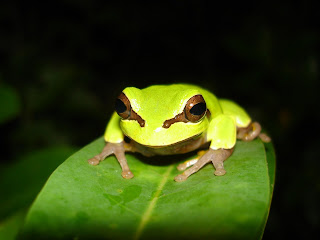


This is what their tadpoles look like. These treefrogs only breed in small, acidic pools (like the one below), with dense cover (second photo down), so they can be pretty difficult to find, or even approach.


Here's a video of one that wasn't too shy to sing in the spotlight:


Though common, I always enjoy finding Green Treefrogs (Hyla cinerea).


These next two species are very similar in appearance, both having mottled, bumpy skin, with light marks below the eyes. In hand, it's pretty easy to tell them apart, and if they vocalize, they sound completely different.


Bird-voiced Treefrog (Hyla avivoca)


Cope's Gray Treefrog (Hyla chrysoscelis)

With their flexible, sticky toepads, treefrogs are adept at grabbing on to and climbing almost anything. They don't, however, have exclusive claims on climbing skills. The Spring Peeper (Pseudacris crucifer), usually seen on the ground, is also quite capable of climbing like a treefrog and could understandably be mistaken for one in the position seen below.


Pine Woods Treefrog (Hyla femoralis)


Spring Peeper (acting like a treefrog)

This first salamander is especially interesting to me, because it is a species that has not yet been described in literature. It will probably be called the Eglin Ravine Dusky Salamander (Desmognathus ?), and is in the process of being worked up by Bruce Means.


Dwarf Salamander (Eurycea quadridigitata)


Three-lined Salamander (Eurycea guttolineata) (I couldn't resist including this video of one walking. I love how they move.


One of my favorites, Marbled Salamander (Ambystoma opacum)


Similar to the amphiuma that I posted recently, and another species as yet undescribed in literature, this is a Siren (Siren cf intermedia).

This first snake was the oddest lifer snake I've ever seen. It's an albino Southeastern Crowned Snake (Tantilla coronata). My friend Norm Friedman spotted it.


In North America, a relatively few snake species have some ability to protect themselves with powerful venom. Interestingly, at least 25-35% of our harmless snake species arguably enjoy some degree of protection by mimicking those venomous snakes (H. Greene, Snakes 1997). The Dusky Pigmy Rattlesnake (Sistrurus miliarius barbouri), a pitviper, is an example of a venomous "model" species on which a few mimic species can piggyback.


Dusky Pigmy Rattlesnake

This young Eastern Hognose (Heterodon platyrhinos) is an example of a pitviper mimic that could be confused for a pigmy rattler. Besides having a similar appearance, hognose snakes will supplement the effect by putting on some pretty threatening displays (see recent post for video of this).


Eastern Hognose


Redbelly Snake (Storeria occipitomaculata)

This was a rare occasion where a Florida Softshell (Apalone ferox) was actually far enough from the water that it couldn't retreat when I approached it.


I found these last two shallowly submerged in backwaters of the Yellow River where they were sleeping at night.
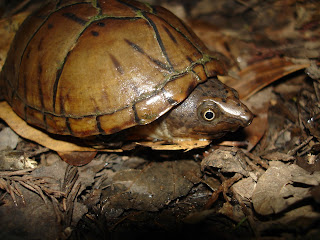

Loggerhead/Stripeneck Musk Turtle intergrade (Sternotherus minor)


young Florida Cooter (Pseudemys floridana)

7.04.2008

Proud Aunt & Uncle (x2!)


We are so happy to have Henry Keith as the newest addition to the Jones family! We can't wait to meet this beautiful boy in person! Congratulations Chris & Jess!

6.24.2008

Baby birds

In the past couple months at work, I've been spending a lot of my time doing nest searching and monitoring. We maintain a nearly 100% banded population of Red-cockaded Woodpeckers within a large part of Eglin, and banding nestlings is much more efficient than trying to band all of these birds as adults.


This baby RCWO is about seven days old. It can't open it's eyes yet, but has plenty of strength to lift it's head and beg for food.


I happened upon this Common Nighthawk nest shortly after the two nestlings had hatched. The second chick is hidden behind this one, and is still wet from being inside the egg.


We use cameras on telescoping poles to look into the nest cavities. This is a video of the monitor showing three young nestlings. When I turn the camera light off, it simulates an adult blocking the light when bringing food, thus the begging.


This is a long video of me climbing a tree to capture two nestlings to band them. We use a noose to pull them out of the hole.

6.23.2008

June FL herps

I sometimes think I might be winding down on the cool new things to see around here. I'm always glad to be wrong on that point.


Male Pig Frog (Rana grylio)


This Two-toed Amphiuma (Amphiuma means) was huge (~4.5 cm wide at head, probably 2.5-3' long). It took two crayfish out of my fingers. Their bite (referring to being handled by humans) has been described as "savage," with crushing strength and razor-sharp teeth. We made a couple attempts at capturing it after luring it partly out of its ambush spot, but perhaps it was best that we didn't get it in hand.


Male Broadhead Skink (Eumeces laticeps), another good biter.


Northern Scarlet Snake (Cemophora coccinea copei), an exciting find that I'd been looking forward to for quite some time. This is of course one of the neat coral snake mimics. Admittedly, I had to pause for a second just to make sure.


This is a well-marked Eastern Hognose Snake (Heterodon platirhinos). They put on an intimidating display, but they're all bark and no bite in my experience. Unfortunately, they're often killed when people mistake them for a venomous snake. Toads make up a large part of their diet.


This young Eastern Mud Snake (Farancia abacura abacura) was probably the coolest animal I've seen in quite a while. There's something satisfying about finally seeing something that you've been looking forward to for years. My friend Brandon spotted it, so a huge thanks to him.